
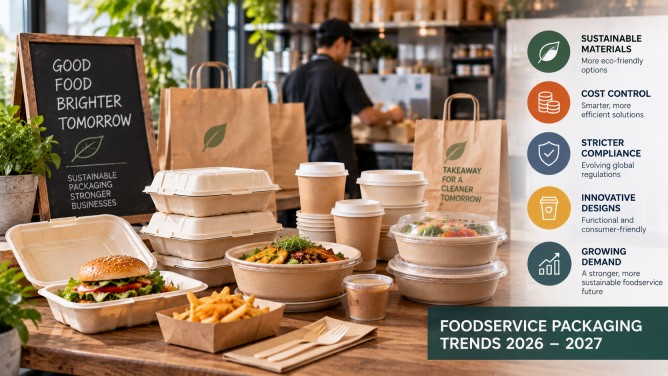
As we approach 2026-2027, the trends in foodservice packaging are increasingly focusing on performance in takeaway settings, adherence to regulatory requirements, and the development of application-specific barrier solutions. Restaurants, distributors, and food brands are shifting their approach to sustainable packaging by examining not just the replacement of plastics but also the performance, overall cost, and verified claims of the products they use. Key considerations include the handling of hot, oily, and moisture-rich foods, which necessitate stronger takeaway packaging, and the evaluation of total landed costs over unit prices alone. Additionally, compliance with PFAS, compostability, and food-contact regulations requires proper documentation at the product level.
Takeaway packaging is becoming more performance-driven, needing to withstand various challenges such as heat, steam, grease, and transportation while maintaining its structural integrity and presentation. Molded sugarcane bagasse is popular for many hot food applications due to its combination of rigidity and fiber-based appearance. For more demanding applications, PFAS-free barrier treatments and coatings may be necessary. Restaurants and distributors are advised to test packaging with real menu items to determine the suitable container size, barrier level, and lid design before committing to bulk orders.
In terms of cost control, factory-direct sourcing is playing an increasingly significant role. The actual cost of food packaging is affected by freight, warehousing, and inventory expenses, prompting buyers to look at total landed costs rather than just the quoted unit price. This comprehensive cost includes factors such as freight, warehousing, inventory holding, and potential packaging failure costs. Direct collaboration with food packaging manufacturers can enhance visibility into production processes, quality control, and customization options, potentially reducing intermediary costs and providing benefits for OEM/ODM programs.
Regulatory compliance is becoming more focused on verifiable documentation, especially for claims regarding PFAS-free, compostable, and food-safe packaging. This is crucial for businesses serving European markets, where regulation (EU) 2025/40 will introduce specific PFAS concentration limits in food-contact packaging starting August 12, 2026. Buyers must verify regulatory requirements and request necessary documentation for finished products. Compostability should be evaluated at the finished-product level, considering all components like coatings, laminates, inks, adhesives, and lids.
Finally, ensuring a reliable manufacturing capacity is vital for consistent supply. Restaurant groups, supermarkets, and packaging distributors increasingly assess a supplier’s manufacturing facilities, equipment, quality-control systems, and ability to support repeat orders. Companies like Grizzlies, with extensive production capabilities and OEM/ODM experience, offer a range of factory-direct bagasse food packaging solutions. By emphasizing performance, compliance, and application specificity, foodservice buyers are encouraged to carefully evaluate packaging options in light of the evolving trends and requirements of the industry.
Legal Disclaimer:
The information contained in this article has been provided by independent third-party contributors, clients, or content partners. We do not independently verify the accuracy, completeness, legality, ownership, licensing, or reliability of submitted content, including text, images, videos, trademarks, or other media materials. The submitting party is solely responsible for ensuring that all content, including images and media assets, complies with applicable copyright, trademark, licensing, and intellectual property laws. We disclaim liability for any unauthorized use of copyrighted or proprietary materials by third parties. If you believe that any content published on this platform infringes your intellectual property rights, kindly contact the author above for prompt review and resolution.